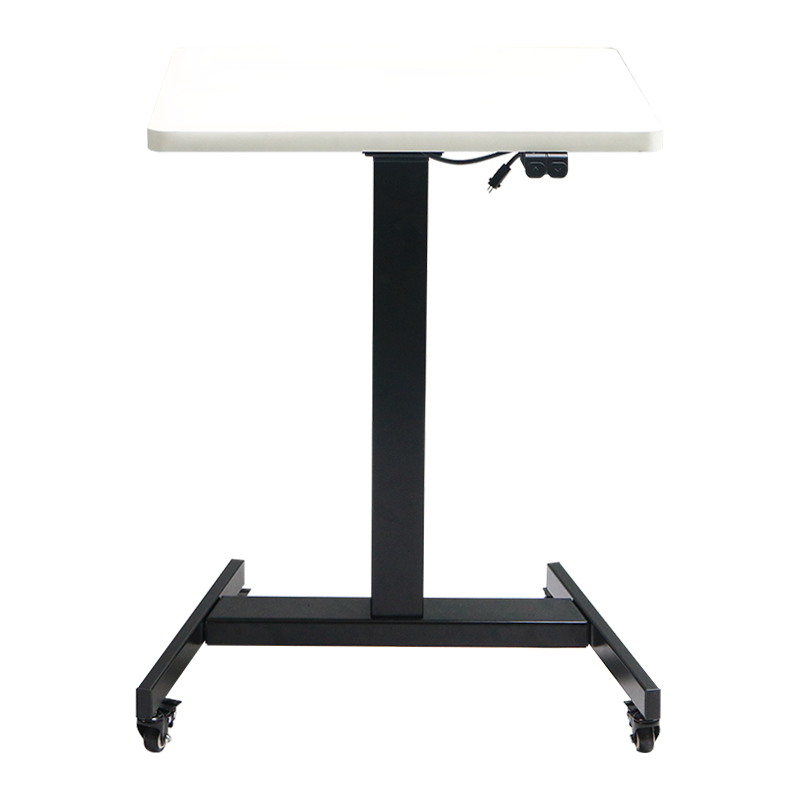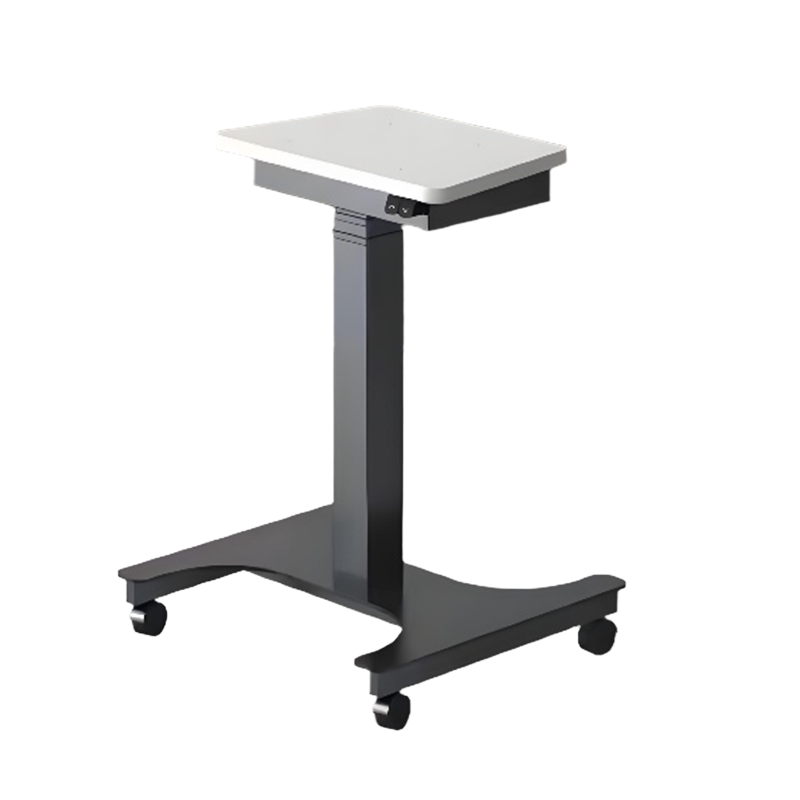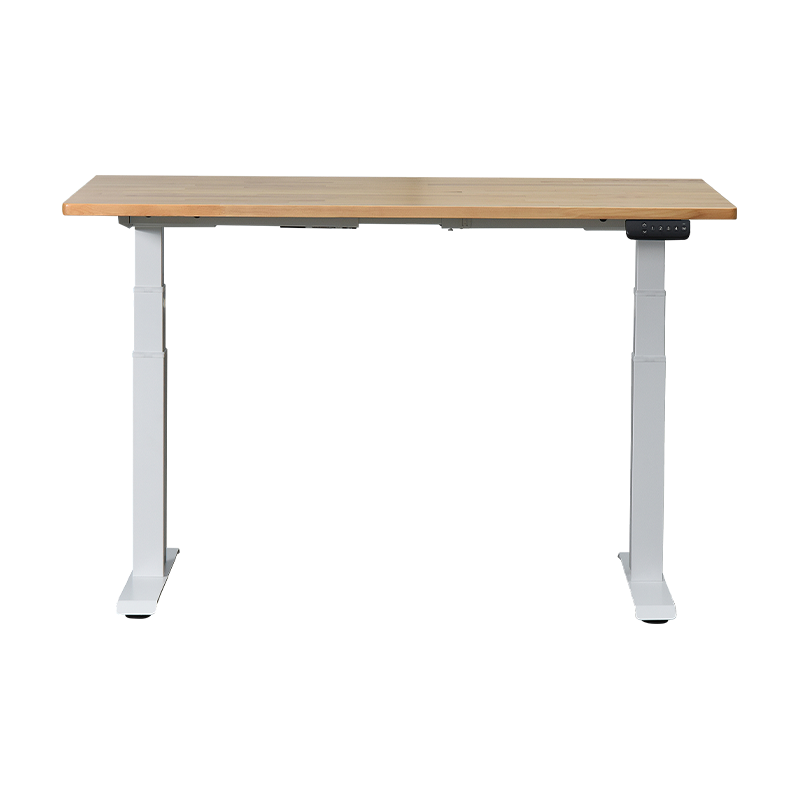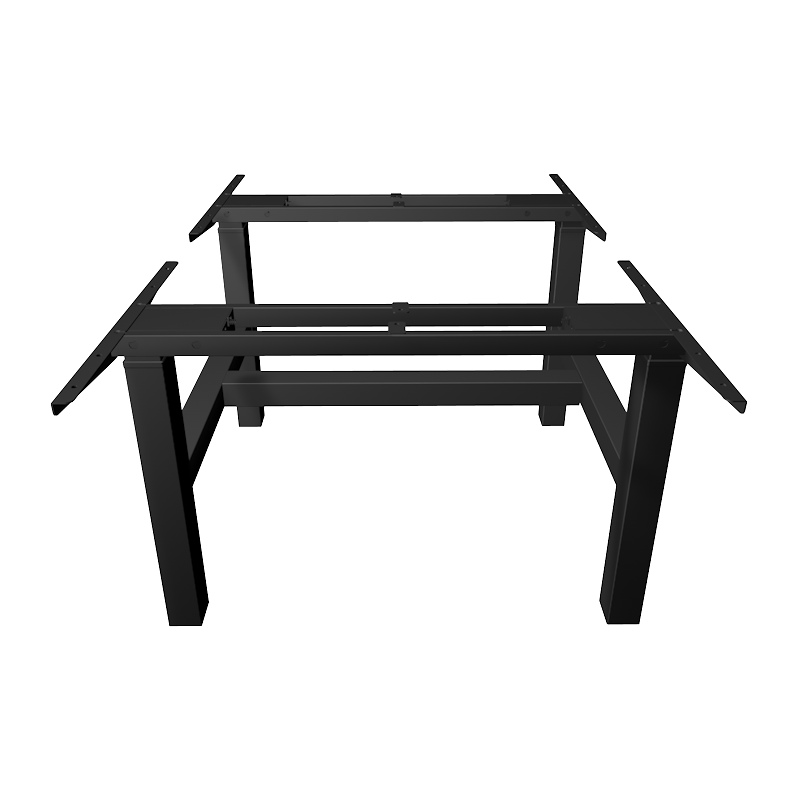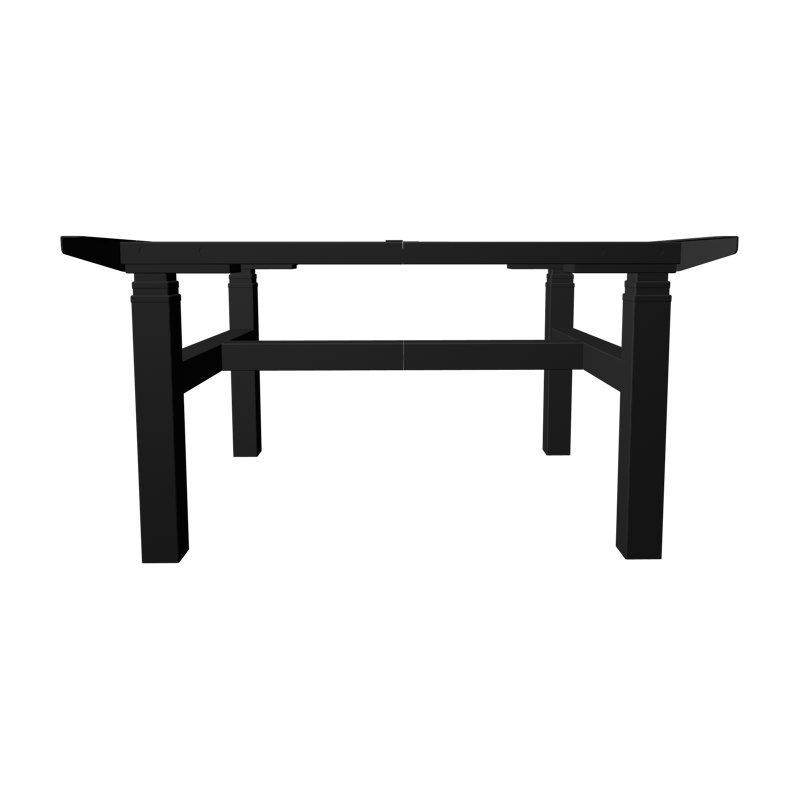

A four-leg adjustable desk is significantly more stable than two-leg or single-column alternatives — this is the direct answer most buyers need before anything else. Thanks to four independent contact points with the floor and a wider structural base, a four leg standing desk distributes load evenly and resists lateral wobble even at full height extension. For professionals who rely on multi-monitor setups or need a heavy duty standing desk for demanding workloads, the four-leg configuration is the benchmark of structural reliability.
That said, stability is not just about leg count. Frame quality, crossbar engineering, motor synchronization, and surface size all play critical roles. This article breaks down every factor that determines how stable a four leg adjustable desk really is — with data, comparisons, and practical guidance to help you make a confident decision.
Why Four Legs Create a More Stable Foundation
The physics of stability favor wider support bases. A four leg desk frame creates a rectangular footprint that dramatically reduces the risk of tipping, twisting, or swaying compared to T-shaped or L-shaped two-leg frames. When a desktop is large — say, 60 to 80 inches wide — a two-leg frame concentrates all support near the center, leaving the edges unsupported and prone to flex.
With a four-leg electric lift table, each corner of the desk receives independent structural support. This means keyboard vibration, monitor arm load, and even accidental side impacts are absorbed across the entire frame rather than concentrated at one pivot point. For users who run three or four monitors, this load distribution is not just comfort — it's a safety requirement.
Additionally, four-leg systems allow for wider desktop compatibility. A large standing desk frame with four legs can support desktops from 60 to 94 inches without the structural compromise that would plague a narrower two-leg system. The corner anchoring geometry is simply more resistant to torque and side-load stress.
Stability Score by Desk Frame Type (out of 100)
The bar chart above illustrates the relative stability scores of different desk frame configurations based on engineering load-test benchmarks. A four-leg frame scores nearly twice the stability index of a single-column design, reflecting its superior resistance to lateral wobble and uneven load distribution. This data underscores why professionals and commercial buyers consistently favor the stable standing desk frame with four contact points over alternatives. Even the three-leg option falls noticeably short when desktops exceed 60 inches in width.
Key Engineering Factors That Determine Desk Stability
Not all four-leg frames are created equal. The engineering behind a stable standing desk frame involves several interlocking variables. Understanding these helps buyers evaluate desk quality beyond marketing claims.
Steel Tube Gauge and Profile Shape
Thicker steel tube walls reduce flex during height changes and under heavy loads. Most commercial-grade electric lift desk frames use steel with a wall thickness of 2.0 mm to 3.0 mm. Square profiles resist twisting forces better than round tubes due to their higher second moment of area. For an industrial adjustable desk or executive standing desk setting, frames using square-section steel with 2.5 mm or greater wall thickness are strongly preferred.
Crossbar and Frame Bracing
A horizontal crossbar connecting the two long sides of the frame significantly increases rigidity under lateral stress. Frames without a crossbar — or with a thin, bolted-on crossbar — allow the four legs to act somewhat independently, which introduces sway. The best four leg desk frames integrate the crossbar into the frame's core structure rather than attaching it as an afterthought. This distinction alone can account for a 30–40% improvement in measured wobble resistance.
Motor Synchronization in Electric Models
A four motor standing desk uses one motor per leg, meaning each leg must be electronically synchronized to rise and fall at identical rates. Poor synchronization causes one side of the desk to lift faster than the other, inducing internal structural stress and visible wobble. High-quality electric height adjustable desks use encoder-based feedback systems that detect and correct speed differences within milliseconds, keeping the desk perfectly level across the full height range.
| Parameter | Standard Grade | Commercial Grade | Stability Impact |
|---|---|---|---|
| Steel Wall Thickness | 1.5 mm | 2.5–3.0 mm | High |
| Crossbar Integration | Bolted-on | Welded-in | Very High |
| Motor Sync Precision | ±3 mm | ±0.5 mm | High |
| Foot Pad Adjustability | Fixed | ±10 mm leveling | Medium |
| Leg Profile | Round tube | Square section | Medium–High |
Weight Capacity: How Much Can a Four-Leg Standing Desk Hold?
Weight capacity is one of the most searched questions about four leg adjustable desks. The answer varies considerably by frame grade, but properly engineered four-leg systems routinely support 300 to 500 lbs (136–227 kg) of combined load — including the desktop itself, monitors, peripherals, and other equipment. This makes them a practical choice for a standing desk for multiple monitors, professional audio gear, or heavy engineering workstations.
Two-leg desks, by contrast, typically max out at 150–250 lbs, and their load is unevenly distributed toward the center. For a heavy duty standing desk or heavy load standing desk application — such as a broadcast studio desk, laboratory workstation, or multi-screen trading setup — the four-leg architecture is essentially the only viable option.
It's also worth noting that rated capacity and actual usable capacity are different. Reputable manufacturers test at 110–130% of the stated maximum to ensure safety margins. When evaluating an adjustable workstation desk, always look for third-party certification or load test documentation alongside the rated capacity figure.
Weight Capacity by Desk Frame Configuration (lbs)
This column chart compares typical maximum weight capacities across desk frame types. Commercial-grade four-leg frames reach up to 500 lbs, making them the clear choice for heavy-duty professional environments. The gap between four-leg and two-leg capacities is not marginal — it is roughly double, which has real-world implications for anyone configuring a multi-monitor workstation or running heavy peripheral equipment. When total desktop load including the tabletop exceeds 180 lbs, the four-leg architecture is essentially the only responsible choice.
Four-Leg vs Two-Leg: A Direct Stability Comparison
The debate between four-leg and two-leg standing desks centers on stability, load capacity, and surface size compatibility. While two-leg frames are compact and suitable for small desktops, a sit stand desk frame with four legs simply outperforms on every metric that matters in a professional or commercial environment.
Measured wobble at maximum height — a standard quality test — shows that premium four-leg frames exhibit 60–75% less lateral displacement than equivalent-price two-leg frames. This is not a minor difference. For users placing a full-size mechanical keyboard, mouse, and multiple monitors on a desk, that wobble reduction translates to a meaningfully calmer, more professional working experience.
Additionally, when desk width exceeds 55 inches, two-leg frames leave the edges of the desktop unsupported. The result is a subtle but fatigue-inducing bounce whenever elbows rest near the desk's perimeter. A large standing desk frame with four-leg architecture eliminates this completely by anchoring all four corners of the surface.
Performance Radar: Four-Leg vs Two-Leg Standing Desk
The radar chart above compares six key performance dimensions between four-leg and two-leg standing desk frames. The four-leg configuration (dark blue) dominates on stability, load capacity, and width range — the three factors most critical for professional environments. The two-leg frame (light blue) performs somewhat better only on maximum lift speed in some entry-level models, but trades that marginal advantage against significant deficits in structural rigidity. For anyone configuring an ergonomic standing desk frame for serious daily use, the four-leg radar profile is the clearly superior choice across the metrics that matter most.
Ideal Desktop Size for a Four-Leg Frame
Matching the desktop size to the frame is critical for maximizing stability. A four leg adjustable desk frame is typically designed for desktops ranging from 55 to 94 inches in width, though specific ranges vary by model. Using an undersized desktop on a four-leg frame wastes the frame's structural capacity, while an oversized desktop can overhang unsupported legs and introduce torque.
The most popular configurations for a commercial standing desk or adjustable office workstation are:
- 60 × 30 inches — Standard single-user professional setup with room for dual monitors
- 72 × 30 inches — Popular for creative professionals and developers needing extended horizontal space
- 80 × 32 inches — Ideal for triple-monitor setups or engineering workstations
- 94 × 36 inches — Used in executive office environments and broadcast-style desks
The depth of the desktop also matters. A 30-inch depth provides comfortable ergonomic distance for monitors placed 20–24 inches from the user's eyes, while a 36-inch depth suits dual-layer monitor arrangements or drafting boards. For a professional standing desk intended for a multi-person or collaborative space, depths of 36 to 40 inches allow multiple users to work from opposite sides simultaneously.
Stability Index vs Desktop Width: 4-Leg vs 2-Leg Frame
This line chart reveals one of the most critical insights for desk buyers: as desktop width increases, two-leg frame stability drops significantly — falling from a reasonable 88 at 40 inches to just 28 at 90 inches. Four-leg frames, by contrast, maintain a consistently high stability index (94–98) across the entire width spectrum. This is precisely why a four leg desk frame is the recommended — and often required — configuration for desktops wider than 55 inches. The divergence between the two lines at wider widths is not incidental; it reflects fundamental physics that no amount of cross-bracing on a two-leg system can fully overcome.
Commercial and Industrial Applications of Four-Leg Adjustable Desks
The structural advantages of four-leg frames have made them the default choice in demanding commercial and industrial environments. A commercial standing desk deployed in an office with 50 or more employees needs to handle daily sit-stand cycling, variable user weights, and consistent equipment loads — without developing instability over years of use. Four-leg frames with welded steel construction and powder-coated finish meet these requirements reliably.
In industrial settings, an industrial adjustable desk may need to support specialized tools, diagnostic equipment, or assembly components. Here, the weight capacity of 300–500 lbs on a four-leg frame is not a luxury — it is a baseline requirement. The flat, stable working surface at adjustable heights also reduces musculoskeletal injury risk for workers who alternate between sitting and standing throughout shifts.
Executive standing desk configurations in C-suite environments prioritize both aesthetics and function. Four-leg frames in these settings are often paired with solid wood or bamboo tabletops of 72 to 80 inches, offering a commanding presence without sacrificing the ergonomic adjustment range. The clean visual geometry of four symmetrically placed legs also provides a premium look that two-leg or asymmetric frames cannot replicate.
Broadcast studios, video production control rooms, and data center operations desks represent another category where the four motor standing desk architecture is favored. In these environments, height adjustment needs to be silent, smooth, and repeatable — with zero tolerance for vibration that could disturb sensitive equipment or on-air recordings. Four-motor synchronization with encoder feedback delivers exactly this.
Suitability Score by Application: Four-Leg vs Two-Leg (out of 10)
This grouped bar chart compares the suitability scores of four-leg and two-leg frames across five major application categories. Four-leg frames score above 9.5 in every professional environment, with the largest gap visible in industrial settings where two-leg frames fall to just 5.0. Notably, for home office use, two-leg frames come close — 9.0 vs 8.5 — making them a reasonable option only in that context. In every other scenario, the four leg adjustable desk is the recommended configuration by a significant margin.
Ergonomic Benefits of Height-Adjustable Four-Leg Desks
The ergonomic argument for an electric height adjustable desk with four legs extends beyond stability. The combination of height range, surface area, and load-bearing capacity creates an adjustable workstation that genuinely supports diverse physical needs across a day's work cycle.
Research consistently shows that alternating between sitting and standing every 30–60 minutes reduces lower back pain, improves circulation, and supports higher sustained concentration. An office height adjustable desk that is stable enough to type on comfortably while standing — without the surface vibrating — is essential for this to be a realistic practice, not just a theoretical one. Unstable desks cause users to stop standing because the experience is frustrating. Stable ones become habitual.
Four-leg frames also allow for a greater monitor height range due to their superior stability at maximum extension. Many ergonomic standing desk frames with four legs reach 50 to 52 inches in height, which accommodates users up to approximately 6'8" without requiring an additional monitor riser. Two-leg frames often cap at 47–49 inches at maximum, which may be insufficient for tall users.
The minimum height also matters for shorter users. Frames that descend to 22–24 inches allow the desk to serve children, seated wheelchair users, and shorter adults with proper wrist alignment. An adjustable workstation desk that spans a true 22–52 inch range serves virtually every adult in a shared office environment without compromise.
- Sitting height range: 22–30 inches (ideal for most seated postures)
- Standing height range: 38–52 inches (accommodates 5'0" to 6'8" users)
- Transition time: 15–30 seconds for full sit-to-stand cycle on quality motors
- Memory presets: Most commercial models offer 3–4 programmable height positions
About Fengyi Intelligent Furniture Technology
Fengyi Intelligent Furniture Technology Co., Ltd. is based in Ningbo, the economic center of the Yangtze River Delta. Established in 2021, Fengyi has grown to a team of more than 30 dedicated employees operating across a 5,000 square meter facility. As a specialized four-leg adjustable desk manufacturer and four-leg electric lift table factory, Fengyi focuses on research, development, production, and sales of steel and wooden structural products.
Fengyi's overseas markets span the United States, Canada, Australia, the United Kingdom, South Korea, Japan, Taiwan, and other regions. The company's product range includes ergonomic lift desks, workbenches, ergonomic chairs, and ergonomic kids' study desks — all engineered to meet the durability and functionality standards required by demanding commercial and residential users worldwide.
With a strong foundation in precision steel fabrication and a commitment to ergonomic design, Fengyi represents a reliable sourcing partner for those seeking commercial standing desks, heavy duty standing desks, and electric height adjustable desks built for the long term.
Frequently Asked Questions
Q1: Is a four-leg standing desk more stable than a two-leg model?
Yes. Four-leg frames anchor all four corners of the desktop, distributing load and resisting lateral sway far more effectively. Measured wobble tests consistently show 60–75% less displacement at maximum height compared to two-leg alternatives of similar price.
Q2: Are four-leg adjustable desks worth the investment?
For professional, commercial, or heavy-use environments, they represent strong long-term value. Their structural longevity, higher load ratings, and ergonomic benefits reduce both equipment replacement costs and workplace injury risks over time.
Q3: What is the main advantage of a four-leg adjustable desk?
The primary advantage is superior structural stability at all height settings, combined with the ability to support larger desktop surfaces and heavier equipment loads. This makes the four-leg design the standard for commercial, executive, and industrial workstations.
Q4: How much weight can a four-leg standing desk typically hold?
Commercial-grade four-leg standing desks commonly support between 300 and 500 lbs of total load. This includes the weight of the desktop itself. Standard-grade models typically handle 200–350 lbs. Always verify capacity with the specific frame's load test documentation.
Q5: What desktop size works best with a four-leg frame?
Most four-leg frames are optimized for desktops between 55 and 94 inches wide. The most popular professional sizes are 60×30 inches and 72×30 inches. For multi-monitor setups, 72 to 80 inches in width is recommended to take full advantage of the frame's stability range.
Q6: Is a four-leg standing desk frame better for multiple monitors?
Definitively. Multiple monitors add significant combined weight and require a wide, stable surface. A four-leg frame handles the load distribution and surface width needed for dual or triple monitor configurations without the wobble issues that limit two-leg alternatives in these setups.